
MEMBRANE-BASED WFI GENERATION BY RO + UF

PRODUCING "COLD" WATER FOR INJECTION w/ MEMBRANE-BASED RO SYSTEMS
Is there safety in the production of WFI by Reverse Osmosis? The requirements for "cold" WFI systems have been the subject of much discussion in recent years. ISPE (International Society for Pharmaceutical Engineering) published a Good Practice Guide about the Membrane-Based WFI Systems. In the past, the European Pharmacopoeia (Ph.Eur.) permitted the use of distillation only for producing WFI; this changed in 2017. Therefore, the use of membrane technology as an alternative is now also permitted. Alongside an increasing focus on costs, pharmacopeias worldwide have concentrated on WFI quality attributes, thereby allowing for the consideration of alternative production technologies aimed at reducing manufacturing costs. However, Bram-Cor’s experience —as well as ISPE guidelines— advises evaluating not only the initial investment cost (CAPEX) but also long-term maintenance costs (OPEX). This must be done while also factoring in the risks inherent in cold generation and distribution, as well as the additional critical issues involved if the water produced in the loop is subsequently heated. BRAM-COR is committed to providing a clear answer to every need of water treatment to produce pharmaceutical waters (i.e. PW or WFI) or at least critical applications (cosmetics, healthcare, human food and animal feed, for example). So, our approach is really focused, with a wide range of specific knowledge, also in membrane-based RO systems.
WFI AND GRADE WATERS WITH REVERSE OSMOSIS
We believe that every pharmaceutical facility needs “pure” water. First of all, the question is: what this word, “pure”, means? In order to answer this question, it is necessary to go back to the source and analyse the quality of the water in-situ (the raw water used), which varies greatly from place to place. Then, the task of the pre-treatment of water is just that: bring the particular water to a functional quality, according to the user requirements specification (URS). The nature of the feed water is a crucial factor in determining whether or not it is advantageous to use reverse osmosis for WFI production.
Bram-Cor water treatment systems are custom-designed to ensure consistent WFI quality worldwide, based on a thorough analysis of the local feed water—a factor that heavily influences the choice of technology.
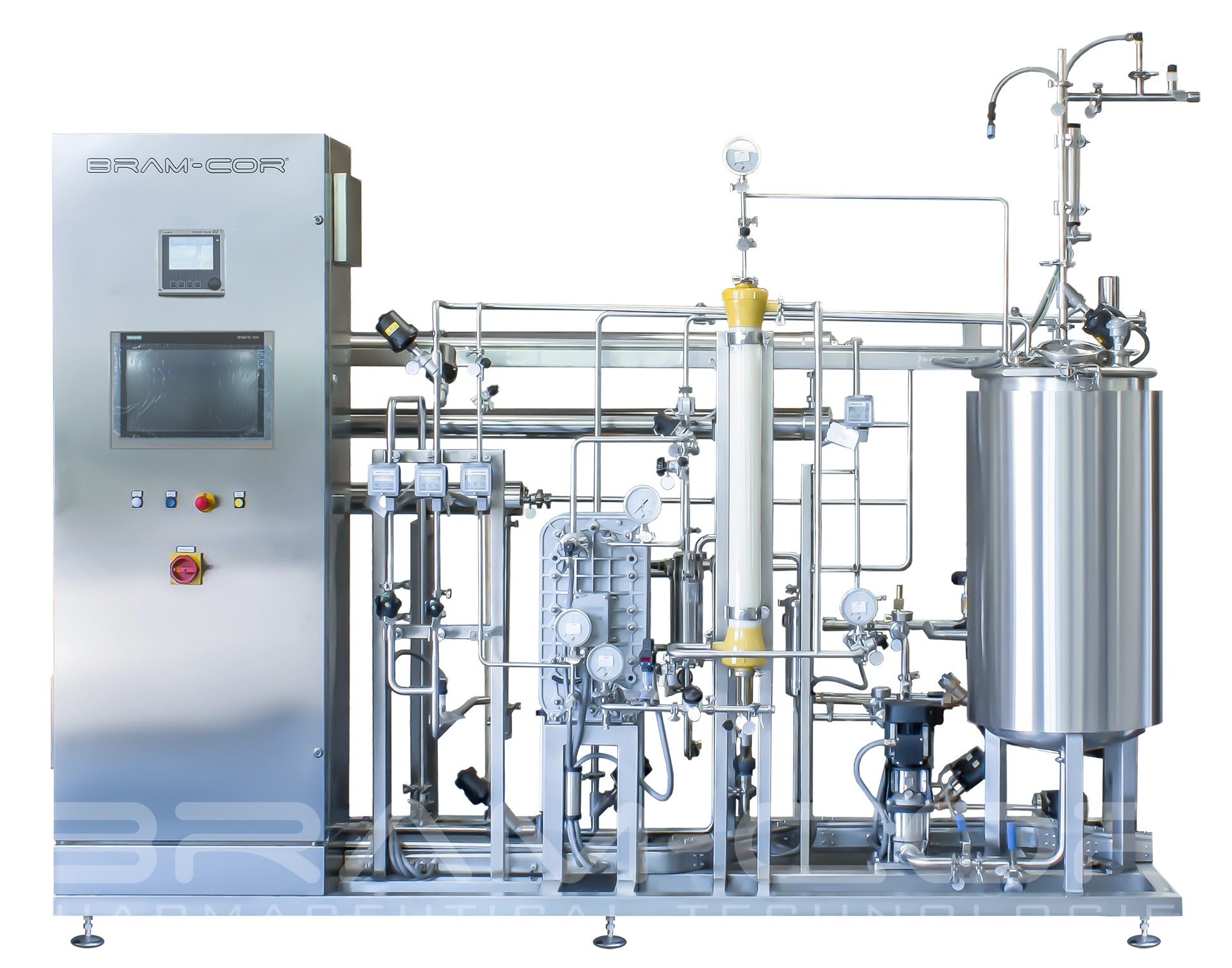
"Cold" Membrane-WFI from RO requires Ultrafiltration (UF)
RO and Water Pretreatment Systems
The raw water must be pre-treated to remove contaminants (such as particulates, calcium and magnesium salts, heavy metals, organics and bacteria) through a multiplicity of different steps (they can include softeners, UV reactors, deionizers, …) Ultraviolet light is employed as a bactericide and to break down organic contaminants. The UV source has a wavelength of 240-260 nm (UV-C) to achieve a absolute reduction of typical pathogenic contaminants.
Chemical dosing stations are added for many purposes such as water disinfection and/or chlorine neutralization. Pre-treated water quality is constantly monitored to ensure suitability to feed downstream water treatment equipments, such as the RO units to produce WFI. For an effective microbial control strategy to prevent biofilm formation and fight against severe contaminations by pseudomonas aeruginosa, BRAM-COR designs and supplies hot water sanitizable versions.
You can enlarge and/or rotate the 3D image
USEFUL LINKS & SYSTEMS KNOWLEDGE
Main site: bram-cor.com
To view Bram-Cor Equipment catalogue
To view where Bram-Cor Equipment works
About pharmaceutical water treatment systems:
multiple-effect-water-distiller.com
vapor-compression-distiller.com
pharmaceutical-reverse-osmosis-systems.com
pure-steam-generator.com
About pharmaceutical process systems and turnkey plants:
bram-cor-pharmaprocessing.com
ivfluids-parenteralsolutions.com
pharmaceutical-turnkey.com
© 2025 BRAM-COR SPA - VIA MERCALLI 12/A - 43122 PARMA - ITALY - P.IVA 01699350342

