
WFI GENERATION BY VAPOR COMPRESSION STILL (VCD)
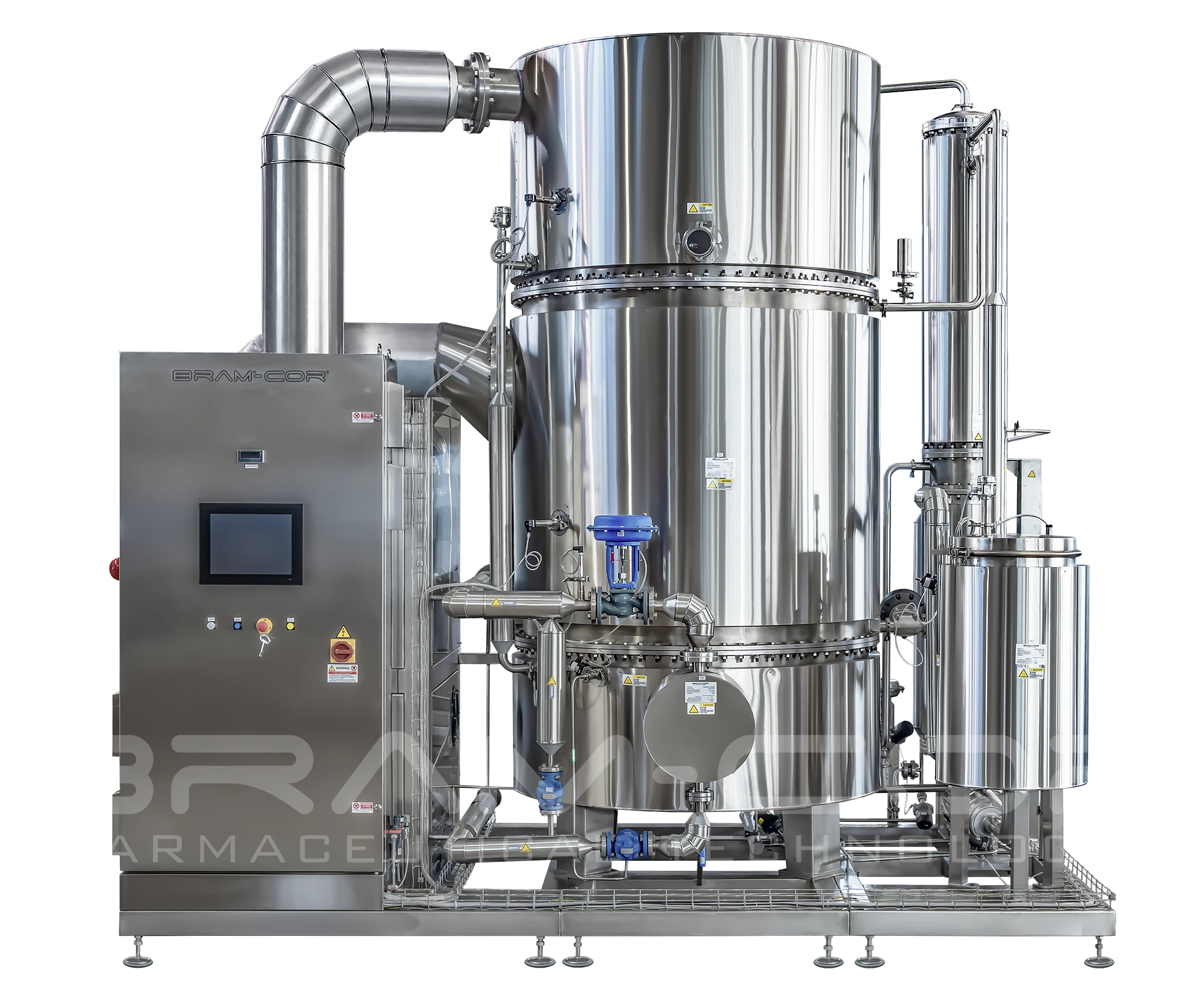
Water for Injection Generators. The rise of a profitable technology.
Everywhere in pharmaceutical world
The Vapor Compression Distiller , as the Bram-Cor STMC model, was improperly called thermocompressor or thermal recompression still. It produces a reliable compendial distilled Water for Injection for pharmaceutical applications. Many products benefit from WFI, such as LVPs (Large volume Parenterals) or SVPs (Small Volume Parenterals) and any injectable product as well as washing medias and special solutions where
- quality factors (such as the sterility, elimination of the pyrogens and low molecular weight chlorine solvents)
- economical factors (low running costs)
are critical to the success of the pharmaceutical process.
Internal pressure is always higher than the atmospheric
The Vapor Compression still always works at an internal pressure higher than atmospheric, preventing outside air from entering the plant. In Bram-Cor VCD the circuit of the WFI is separated from the circuit of the feed water. Moreover, the circuit of the distillate is under positive pressure.
So, in each distillation step, the distillate is always at a pressure higher than the feed water thereby ensuring that in the likelihood of leakage, the feed water will never enter the distillate circuit. As a result, in case there should be any leakage it will be the WFI flowing out to the circuit of the feed water and never the opposite.
Therefore, the usual contamination problems that can arise by any multiple effect distiller after some 4-6 years of operation could never happen in case of Vapor Compression technology. The distinctive feature of Bram-Cor’s VC still—which allows for the production of Water for Injection (WFI) at any temperature between 25°C and 99°C, combined with the ability to obtain the exact quantity of WFI required (from zero up to the system’s maximum capacity)—enables it to adapt to any customer requirement. The same still can be used to produce WFI for both Large Volume Parenterals (LVP) and antibiotics (heat-sensitive injectable products).
The essential parts of Bram-Cor Vapor Compression still

Vapor Compression Distiller operating system (BRAM-COR STMC - Steam heating)
(1) Heat exchanger (for Feed Water preheating and WFI cooling) (2) Heat exchanger (incondensable gas condenser) (3) Distiller tank (4) Condenser (5) Dome (6) Blower (7) Recirculating tank (8) WFI pump (9) Drain manifolds

WFI production with Vapor Compression distillation
The advantage of a higher efficiency
The STMC distillers can produce either cold or hot distillate with huge savings in energy costs and with no need for cooling water. STMC Vapor Compression Distillers operate with electrical heating (STMC EL) or plant steam heating (STMC ST) or even through both electrical and steam heating systems (STMC ES). Capacities range: from 20 to 20.000 lph with one or more blowers.
The design, construction and documentation of the STMC distiller is in strict compliance with GMP and FDA regulations, ensuring an easy certification by the relevant authorities.
In detail:
- The Distiller is made of certified AISI 316L stainless steel
- Any internal part in contact with the infeed water, the Pure Steam and the Distillate is mirror-polished
- All hydraulic connections are sanitary tri-clamp or flange connection
- Any gasket is made in PTFE / EPDM
- All weldings are T.I.G
- Vapor is compressed by a special blower.
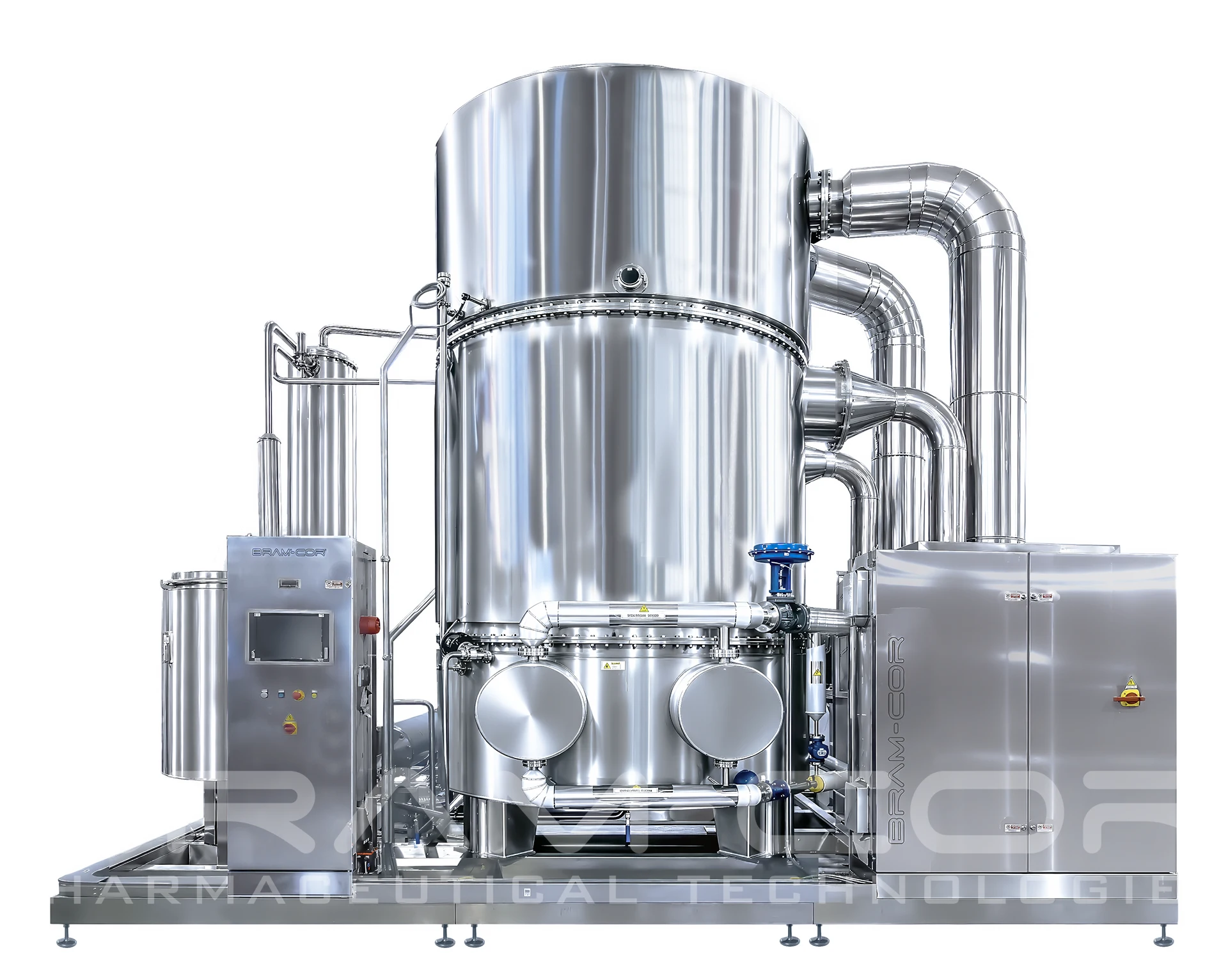
Above: the imposing structure of a Bram-Cor STMC ST 10000, with dual vapor compression systems.
The benefit in WFI manufacturing
- Low energy consumption
- No need for cooling water to condensate the pure steam
- No need for high quality inlet water (in some cases even softened water can feed the VC still)
- Very high quality WFI due to strong degassing process
- No need to pressurize the inlet water
- WFI outflow at high pressure (1 – 1.5 bar) without any additional pump
- Extremely safe process, with no risk of any cross contamination through plant steam or inlet water
- Highest flexibility in terms of capacities and WFI temperatures
- Reduced Maintenance
Note about evaporation
A vertically-mounted compressor will evaporate water on either a falling film or thin rising film principle for drier steam, whereas spray film units direct water over the horizontal surface area of the evaporation tubes for a more wetted surface. Since the separation of impurities from the steam is done by more of mechanical process (vs. multi-effect’s centrifugal action) a secondary separation system is in place. Commonly, a demister pad is used but a newer approach utilizes a baffle similar to those found in multiple-effect stills for a design which is considered more sterile as it is fully drainable. Therefore, a full automation ensures easy operation and total monitoring of critical parameters, by means of certified in-line instruments and of a careful alarm policy. Access policy and records can be managed according to 21 CFR PART 11.
Note about blower
A further enhancement of VCD has been the BRAM-COR multistage blower compressor which runs under 4000 rpm, significantly reducing operating noise level (below 65-70 dB) and maintenance. A standardized approach to mechanical seal design can also reduce the maintenance time typically associated with their changeover as well as prevent or minimize leakage over a longer operating period. The issue of non-condensable gas removal is as standard addressed by vapor compression designs by preceding the compressor with a deaerator.

See also Bram-Cor STMC reference website: vapor-compression-distiller.com
You can enlarge and/or rotate the 3D image

